Algorithms
Climbing Stairs from Two Angles
1. Climbing Stairs from Two Angles
The Climbing Stairs problem on LeetCode is one of those algorithm questions that looks almost too easy. There are n stairs, each move can cover either one or two stairs, and the task is to count how many distinct ordered move sequences can reach the top. For example, for n = 5, 1 + 2 + 2 is a valid climb, but 2 + 1 + 2 is a different valid climb.
There are actually two completely different approaches to solving this task. One is the Fibonacci recurrence. The other is a direct combinatorial count. I solved this challenge some time ago in the combinatorial way. Later I discussed the same challenge with a friend of mine, who solved it with the Fibonacci approach. Both of us were a bit surprised that these two approaches, which felt so different, produced exactly the same result. For me, that discussion made the challenge even more interesting, because it showed how completely different perspectives can lead to the same answer. There are also several ways to implement both ideas, ranging from very inefficient to very practical.
2. The Mental Model: Tiny Tiles
A useful way to look at the problem is to turn the stairs into a board of length n. With this view, the task is to count how many ways a board of length n can be tiled with pieces of length 1 and 2. For n = 5, the answer is 8, where k is the number of tiles of length 2:
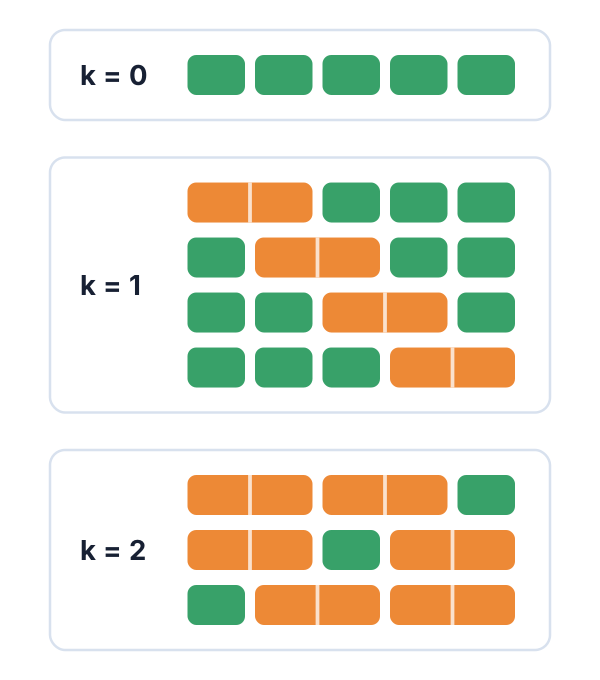
The two different approaches are already visible in the same drawing:
- Fibonacci counts the rows by how they end
- Combinatorics counts the rows by how many
2-tiles they contain
3. Two Different Approaches - Same Solution
W(n) is the number of ordered sequences made only from 1 and 2 whose sum is exactly n. That is exactly the value the Climbing Stairs problem asks for:
For the recurrence, the value of step 0 means that a path has already reached the target and has produced one complete valid sequence. Negative stair counts are impossible, so they add nothing to the calculation:
The Fibonacci numbers are defined as follows:
The Fibonacci approach groups climbs by the final move. Every valid climb to n must end in exactly one of these two ways:
- a valid climb to
n - 1, then one final1-step - a valid climb to
n - 2, then one final2-step
These two groups do not overlap, because a sequence cannot end in both 1 and 2. They also cover every valid climb, because the final move has to be either 1 or 2. Therefore, for n >= 1:
Now compare that with the Fibonacci recurrence. The recurrence has the same shape, but the indexing is shifted by one:
After those two starting values, both sequences follow the same recurrence:
So, by induction we get:
The combinatorics approach starts from the same W(n), but groups the same set of climbs differently. Instead of looking at the final move, fix the number of 2-step moves. Suppose a sequence uses exactly k two-step moves. Those moves cover 2k stairs, so the remaining stairs must be covered by n - 2k one-step moves. That explains the upper bound on k as the sequence must not overshoot the staircase:
For a fixed valid k, the sequence contains k moves of size 2 and n - 2k moves of size 1. So the total number of moves is:
Now the only question is where the k two-step moves are placed among those n - k total move positions. Choosing those positions gives:
Finally, each valid climb has exactly one value of k, so the groups for different k do not overlap. Summing over all possible k values gives the combinatorial formula:
Putting both views together gives:
So the Fibonacci side and the combinatorial side are two different descriptions of the same solution W(n). They count the same set of climbs, just grouped in different ways.
4. Pascal's Triangle As A Sanity Check
Pascal's triangle is useful here as a visual sanity check because it stores binomial coefficients. The combinatorial formula asks for coefficients along this pattern:
So for n = 5, we look for:
This is exactly the staircase formula with the possible values of k plugged in:
The important part is how this maps into Pascal's triangle. I am using the standard zero-based indexing here. The top 1 is row 0, and the first entry in each row is position 0. With that convention, the entry
appears in row r and position c. The reason is the binomial theorem. Row r of Pascal's triangle contains the coefficients of:
For example:
So row 4 is:
In general, the term at position c in row r is:
The coefficient in front of that term is:
That is why Pascal's triangle places this binomial coefficient at row r, position c. So the staircase term:
lives in row n - k and position k. For n = 5, that gives:
Each time k increases by 1, the row number decreases by 1 and the position increases by 1. Visually, that walks one step up and to the right along the shallow diagonal in the picture. In Pascal's triangle, those values sit on one shallow diagonal:
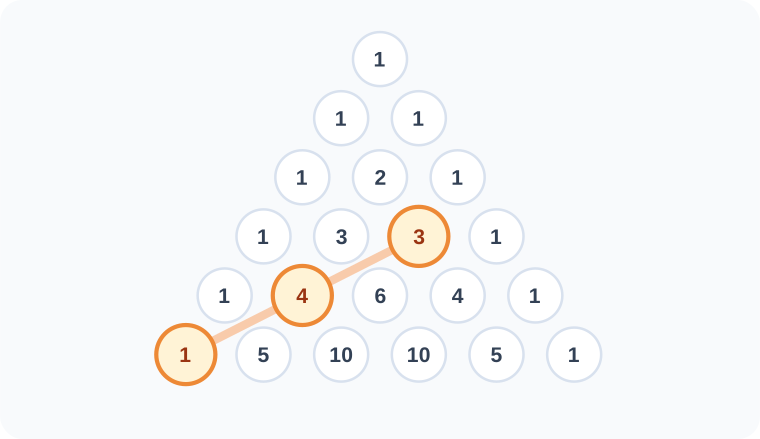
The highlighted diagonal adds up to:
So the picture shows the same result again: there are 8 ways to climb 5 stairs. For n = 6, the same diagonal pattern gives:
So the shallow diagonal sum for n is:
This diagonal pattern appears because Pascal's triangle itself is built by addition:
upper-left + upper-right
          |
       current
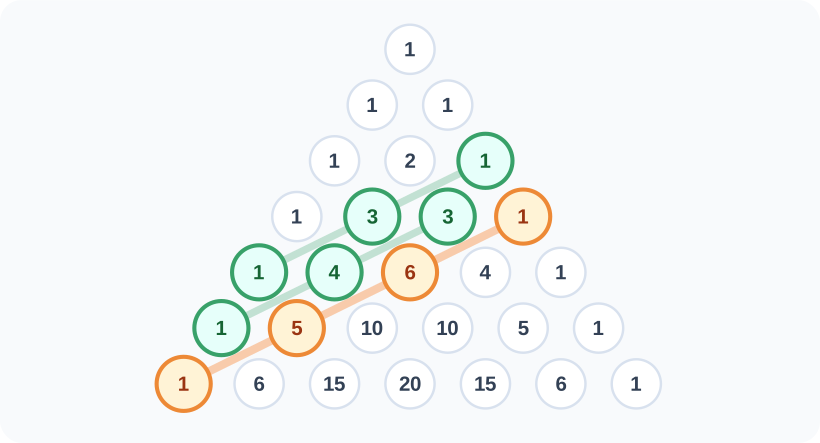
When the correct shallow diagonals are summed, that local addition creates the same shape as the Fibonacci recurrence:
This can also be visualized in Pascal's triangle by comparing the diagonal sums. The two previous green diagonal sums add up to the orange diagonal sum:
5. Implementation Examples
The examples below use the mathematical base case W(0) = 1, so they also behave sensibly for n = 0. LeetCode itself uses n >= 1, so this does not change the accepted answers for the actual challenge.
The complexity formulas use the usual LeetCode model where arithmetic on the returned integers is treated as constant time:
If n is allowed to grow arbitrarily large, the returned value itself has a linear number of bits:
So exact big-integer analysis would add another layer. For comparing the implementation shapes below, the standard model is the useful one.
5.1. Fibonacci Implementations
The Fibonacci family is all about this recurrence:
The variants below differ only in how they compute it.
5.1.1. Fibonacci: Plain Recursion
The most direct implementation is also the worst practical one:
class Solution:
    def climbStairs(self, n: int) -> int:
        if n <= 1:
            return 1

        return self.climbStairs(n - 1) + self.climbStairs(n - 2)
This is conceptually nice and computationally terrible. It recomputes the same values again and again. For example, climbStairs(6) calls climbStairs(5) and climbStairs(4). But climbStairs(5) also calls climbStairs(4). Then each of those calls repeats the same pattern below it. The recursion tree grows exponentially.
The runtime follows essentially the same branching pattern as the Fibonacci recurrence:
So the tighter bound is:
where:
In this context, the symbol φ represents the golden ratio, which is approximately 1.618. It appears here because Fibonacci numbers grow roughly like powers of the golden ratio.
The recursion stack can be as deep as n:
5.1.2. Fibonacci: Memoized Recursion
Memoization keeps the recursive shape but stores already-computed values:
from functools import cache

class Solution:
    @cache
    def climbStairs(self, n: int) -> int:
        if n <= 1:
            return 1

        return self.climbStairs(n - 1) + self.climbStairs(n - 2)
Now every n is computed once. There are only n + 1 possible states from 0 to n:
The cache stores n + 1 values, and the recursive call stack can still have depth n:
This is still clearly a Fibonacci solution. The only difference from the brute-force version is that repeated subproblems are cached.
5.1.3. Fibonacci: Bottom-Up DP
The bottom-up version removes recursion and fills the values in order:
class Solution:
    def climbStairs(self, n: int) -> int:
        if n <= 1:
            return 1

        dp = [0] * (n + 1)
        dp[0] = 1
        dp[1] = 1

        for i in range(2, n + 1):
            dp[i] = dp[i - 1] + dp[i - 2]

        return dp[n]
This is the standard dynamic-programming version. The loop fills each state once:
The array stores one value per state:
It is explicit and easy to debug. It also makes the dependency structure obvious: every cell only depends on the previous two cells.
5.1.4. Fibonacci: Space-Optimized DP
Since dp[i] only needs dp[i - 1] and dp[i - 2], we do not need the full array:
class Solution:
    def climbStairs(self, n: int) -> int:
        prev2, prev1 = 1, 1

        for _ in range(2, n + 1):
            prev2, prev1 = prev1, prev1 + prev2

        return prev1
The loop still advances through the states one by one:
But it stores only the previous two values:
5.1.5. Fibonacci: Matrix Exponentiation
For LeetCode's constraints, the linear DP version is already more than enough. But because this is Fibonacci, the usual Fibonacci machinery also applies.
Matrix exponentiation computes Fibonacci numbers in logarithmic time:
For this problem, the answer is:
So we can compute it with fast exponentiation:
class Solution:
    def climbStairs(self, n: int) -> int:
        def multiply(a, b):
            return [
                [
                    a[0][0] * b[0][0] + a[0][1] * b[1][0],
                    a[0][0] * b[0][1] + a[0][1] * b[1][1],
                ],
                [
                    a[1][0] * b[0][0] + a[1][1] * b[1][0],
                    a[1][0] * b[0][1] + a[1][1] * b[1][1],
                ],
            ]

        def matrix_power(matrix, power):
            result = [[1, 0], [0, 1]]

            while power:
                if power & 1:
                    result = multiply(result, matrix)
                matrix = multiply(matrix, matrix)
                power >>= 1

            return result

        matrix = matrix_power([[1, 1], [1, 0]], n)
        return matrix[0][0]
Binary exponentiation performs a logarithmic number of matrix multiplications. Since the matrix size never changes, each matrix multiplication has constant cost under the standard model:
The iterative implementation stores only a constant number of fixed-size matrices:
5.1.6. Fibonacci: Binet's Formula
Binet's formula is a closed-form expression for Fibonacci numbers:
where:
So:
from math import sqrt

class Solution:
    def climbStairs(self, n: int) -> int:
        phi = (1 + sqrt(5)) / 2
        psi = (1 - sqrt(5)) / 2

        return round((phi ** (n + 1) - psi ** (n + 1)) / sqrt(5))
Under the usual fixed-precision floating-point model, this calculation takes constant time and constant space:
However, the result has to be rounded back to an integer, and floating-point arithmetic is not exact. That is fine for small LeetCode inputs, but for a programming solution I would still prefer the integer DP version.
5.2. Combinatorics Implementations
The combinatorics family evaluates the direct counting formula:
Instead of computing W(n - 1) and W(n - 2), it loops over the possible number of two-step moves.
5.2.1. Combinatorics: Naive Factorials
A first implementation might compute binomial coefficients manually:
class Solution:
    def factorial(self, n: int) -> int:
        if n <= 1:
            return 1
        return n * self.factorial(n - 1)

    def choose(self, n: int, k: int) -> int:
        return self.factorial(n) // (self.factorial(n - k) * self.factorial(k))

    def climbStairs(self, n: int) -> int:
        total = 0

        for k in range(n // 2 + 1):
            total += self.choose(n - k, k)

        return total
This is mathematically clear, but it is not a great implementation. It recomputes factorials for every k, and the recursive factorial calls add avoidable overhead. For each k, this version computes three factorials from scratch:
Under the standard arithmetic model, the total work is:
The deepest recursive factorial call has depth at most n:
5.2.2. Combinatorics: Built-In math.comb
The clean Python version uses math.comb:
from math import comb

class Solution:
    def climbStairs(self, n: int) -> int:
        return sum(comb(n - k, k) for k in range(n // 2 + 1))
For normal LeetCode constraints this is perfectly fine. The loop has one term for each possible value of k:
If math.comb is treated as a primitive operation, the loop complexity is:
The exact runtime of math.comb itself depends on the Python implementation and the size of the integers involved.
5.2.3. Combinatorics: Multiplicative Binomial Coefficients
If you do not want to rely on math.comb, compute binomial coefficients multiplicatively instead of repeatedly building factorials:
class Solution:
    def choose(self, n: int, k: int) -> int:
        k = min(k, n - k)
        result = 1

        for i in range(1, k + 1):
            result = result * (n - k + i) // i

        return result

    def climbStairs(self, n: int) -> int:
        return sum(self.choose(n - k, k) for k in range(n // 2 + 1))
This keeps everything integer-exact and avoids recomputing three factorials per term. For each term, choose(n - k, k) loops:
times. So the total work is:
It only stores a fixed number of loop variables and the current result:
6. Final Thoughts
This problem is small, but the discussion around it made it more interesting than the problem statement first suggested. One person might immediately see the recurrence, while another sees arrangements of 1-steps and 2-steps. Both views are valid, and both count the exact same thing.
That is the useful lesson: different perspectives do not always compete with each other. Sometimes they just put different labels on the same underlying structure. That is usually where the fun part of these small algorithm problems starts.